
Performing Rights: What They Are and Why They Matter for Your Business
Of all the rights bundled into music copyright, one shows up in almost every licensing conversation a hospitality or retail business will ever have. This is the public performance right. Here's exactly what it covers, who manages it, and why it's the specific piece of paperwork your venue needs.
What "Performing Rights" actually mean
The public performance right is the legal requirement to get permission before a copyrighted musical composition is performed publicly, played somewhere other people can hear it. This applies whether the "performance" is:
- A live band playing a cover song
- A DJ playing a track at an event
- A speaker system playing recorded music in a restaurant, bar, hotel, or shop
- Music played over a business's phone hold system
Whenever a business plays music in a space customers or the public can access, it is legally "performing" that music and needs the rights holder's permission to do so.
Who manages Performing rights
Because it would be impossible for every venue to negotiate individually with every songwriter whose music they might want to play, songwriters and publishers assign their performance rights to a Performing Rights Organization (PRO). In the US, the major PROs are:
- ASCAP (American Society of Composers, Authors and Publishers)
- BMI (Broadcast Music, Inc.)
- SESAC
- GMR (Global Music Rights)
Each PRO collects royalties on behalf of the songwriters and publishers who've signed with them, then distributes that money back to the rights holders. In exchange for a fee, a PRO grants your business a blanket license, permission to publicly perform any song in that PRO's catalog, for as long as the license is active.
Why one license isn't automatically enough
Here's the detail that catches almost every business at some point: no single PRO represents every songwriter. A song is often co-written by multiple people, and those co-writers can be signed to different PROs. This means a single popular song might be only partially covered by any one blanket license. To have real freedom over what you play, without checking every track against every catalog, most venues playing a broad range of contemporary music need blanket licenses from multiple PROs simultaneously.
Performing rights vs. other types of music rights.
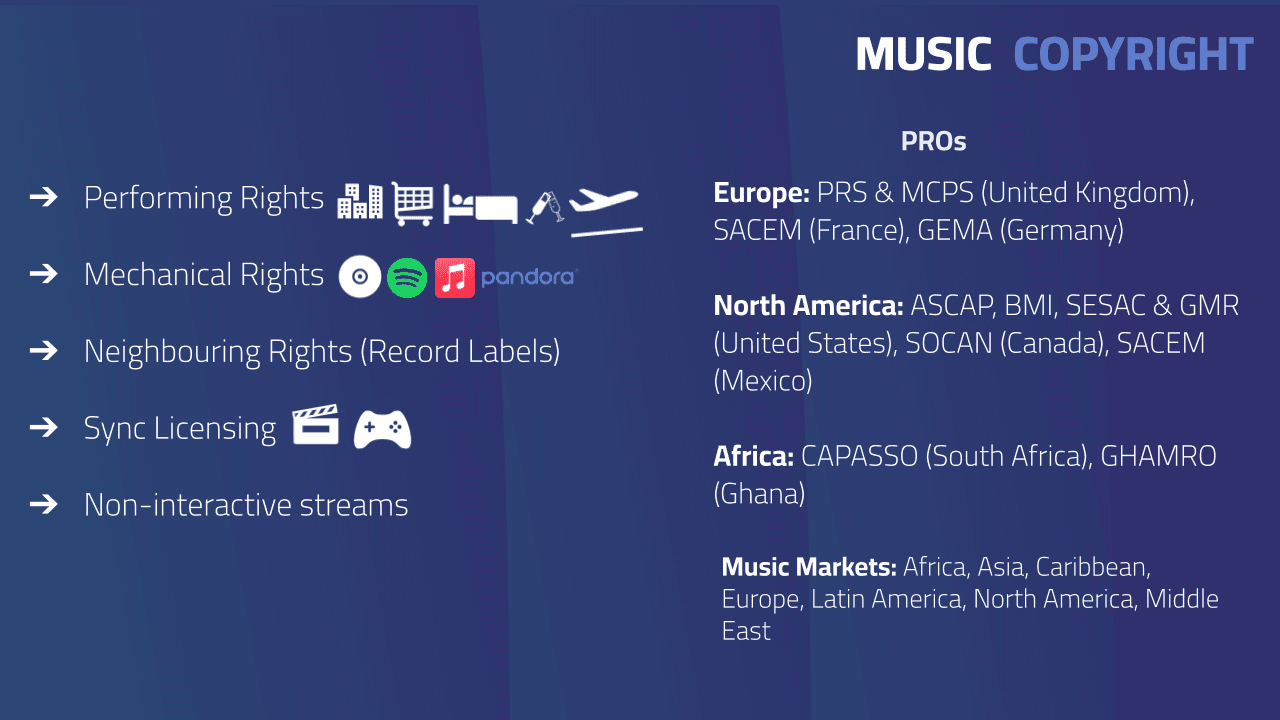
It's worth distinguishing performing rights from a few other rights that sound similar but work differently:
- Mechanical rights cover reproducing and distributing a composition (e.g., pressing a CD or digital download). Not typically what a background-music venue needs.
- Synchronization ("sync") rights cover pairing music with visual media, like a video or ad. Relevant if you're making promotional content, not for playing background music.
- Sound recording rights cover the specific recorded performance, separate from the composition itself, and are often handled differently from PRO blanket licenses (in the US, SoundExchange administers certain digital performance royalties for recordings).
For a typical hospitality venue playing background music, the performing right (composition side) is the piece most commonly missing and the one PROs actively enforce.
How PROs find out you're not licensed
PROs aren't guessing. Common methods include:
- Field representatives who visit venues, note what's playing, and check it against licensing records
- Private investigators, hired specifically to document unlicensed use as evidence for a potential lawsuit
- Public marketing and social media, which PROs monitor for venues advertising live music, DJ nights, or events
- Direct outreach whereby PROs typically contact a business multiple times, by phone and mail, offering a license before ever pursuing legal action
By the time a PRO files a lawsuit, it's rarely a surprise to the business, most cases follow months or years of contact attempts that went unanswered.
The Simple Path
If your venue plays music anywhere customers can hear it, you need performing rights clearance and because of how the rights are split across PROs, that usually means more than one license, not one.
This is exactly the problem a B2B music streaming service like Lobby & Lounge Music is built to solve. We currently partner with independent artists and labels who do not have the benefit of celebrity but have amazing catalogues spanning over 10,000+ tracks. Every track available to play is already cleared across the relevant rightholders, so you never have to cross-check.
In essence, copyright fees are not yet included in your subscription with us and you have to pay any copyright fees with your local PROs (ASCAP, BMI, GMR) once you’re streaming music outside our catalogue represented by these collection societies. Meanwhile, we are working towards expanding our catalogue in the very near future partnerships with the US. PROs so we can work in the PRO fees with one subscription. In the meantime, support Independent artists/labels with one login, one monthly fee and no per-PRO negotiation so you avoid wondering whether today's playlist happens to include a song that isn't covered.