
Do You Qualify for the Small Business Music Exemption?
There's one licensing question we get asked constantly:
"My place is small, do I really need a license?"
Occasionally, the answer is NO.
U.S. copyright law includes a specific exemption for smaller venues playing terrestrial radio or television stations but it's narrower than most business owners assume, and it's easy to accidentally fall outside it.
What the exemption actually covers
Under U.S. copyright law, certain small businesses are exempt from needing a public performance license specifically when playing radio or television broadcasts. The BIG caveat here is: this arrangement is not for streaming services, personal music libraries, or curated playlists).
To qualify, a venue generally needs to meet all of the following at once:
Size limits
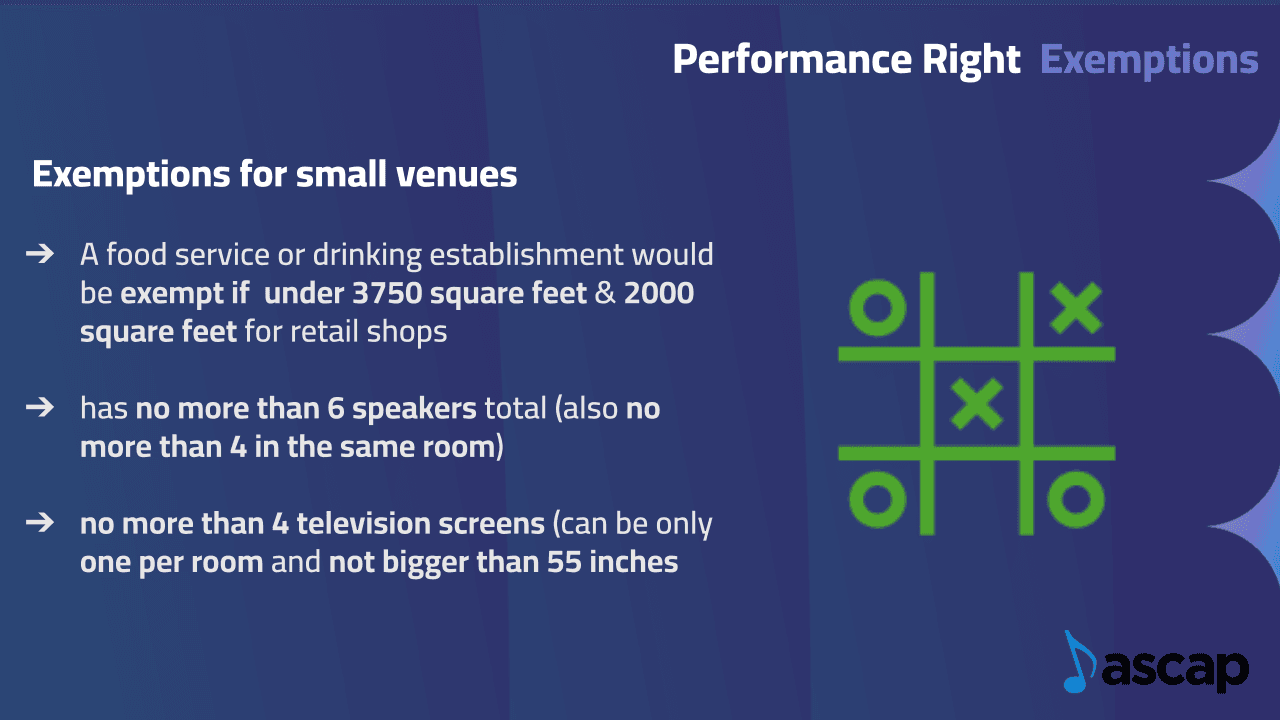
- Food service or drinking establishments (restaurants, bars, cafés): must be under 3,750 square feet
- Retail and other establishments: must be under 2,000 square feet
Audio equipment limits
- No more than 6 loudspeakers total across the venue
- No more than 4 loudspeakers in any single room or adjoining outdoor space
Video equipment limits
- No more than 4 television screens total
- No more than 1 television per room
- No screen larger than 55 inches diagonally
If your venue exceeds any of these thresholds, the exemption doesn't apply and this is where it gets easy to miscalculate. A single large open-plan restaurant with a big bar TV setup, or a retail store with a sound system spread across multiple zones, can blow past the speaker or screen limits well before it approaches the square footage limit.
What the exemption does NOT cover
This is the part that trips people up most. The exemption only applies to broadcast radio and television. It does not extend to: (a) Curated streaming playlists (Spotify, Apple Music, or similar). (b) B2B or commercial music platform's catalog (c)Music from personal devices, CDs, or downloaded files and (d)Any music you actively select, rather than passively receive via broadcast.
In other words, even a venue that comfortably qualifies for the exemption on size and equipment still needs a proper public performance license the moment it wants to play a curated playlist instead of a radio station. The exemption exists for businesses happy to have a TV tuned to a channel or a radio on in the background — not for businesses that want control over their atmosphere.
Why most hospitality venues don't actually qualify
Even where the size and equipment thresholds are met, most restaurants, bars, hotels, and retail spaces don't rely on the exemption in practice, for a simple reason: it forces you to give up control over the audio experience. You can't build a brand-appropriate soundtrack, schedule different moods for different dayparts, or run multiple zones, you're limited to whatever's playing on the broadcast. For any venue that wants an actual atmosphere rather than just legal cover for a TV in the corner, a licensed music platform is the more practical route regardless of whether the exemption technically applies.
Quick reality-check
- Is my venue under 3,750 sq ft (food/drink) or 2,000 sq ft (retail)?
- Do I have 6 or fewer speakers total, with no more than 4 in any one room?
- Do I have 4 or fewer TVs, one per room max, none over 55 inches?
- Am I only playing broadcast radio/TV without a streaming service or curated playlist?
If you answered "yes" to all four, you may be exempt for broadcast use specifically. If you answered "no" to any or if you want to play curated background music rather than whatever's on the radio you'll need a proper license, whether that's direct from the PROs or bundled through a B2B Music Service like Lobby & Lounge Music.
This article is for general informational purposes and is not legal advice. If you're unsure whether your venue qualifies for the small business exemption, consult a qualified legal advisor or reach out to the relevant PROs directly.